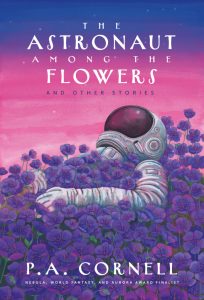
 The Astronaut Among the Flowers and Other Stories
P.A. Cornell
Stars and Sabers Publishing (August 18, 2026)
Reviewed by Andrew Byers
I ran across P.A. Cornell recently in Of Dread, Decay, and Doom, the Stars and Sabers horror anthology, where she turned in a lake-monster story called “From the Ice and the Darkness” that was one of the better pieces in a crowded book. Her contributor bio there mentioned a debut collection coming in August from the same press. This is it, and having now read it, I’m going to say plainly that the bio undersold her. Cornell is a Chilean-Canadian writer who has been quietly stacking up credentials for about eight years—”Once Upon a Time at The Oakmont” was a finalist for the Nebula, the World Fantasy, and the Aurora in the same year—and this collection is the argument for why you should have been paying attention already. Jonathan Maberry contributes an introduction making essentially that same case, and comparing her to William F. Nolan, which seems apt.
Twenty-one stories, a little over two hundred pages, arranged into four parts: Artificial Minds, Unusual Circumstances, Time Distortions, and Visions of the Future. Nearly all are reprints from between 2018 and 2024—Cossmass Infinities, Galaxy’s Edge, Apex, Fantasy, Nature, several Flame Tree anthologies—with two pieces original to the book, the title story and “Everything That I Am.” The reprint sources tell you something: this is a writer who has been publishing in good venues for years without ever quite getting the book-length attention that gets you noticed by the general reader. That’s the gap this collection exists to close.
The obvious standout is “Once Upon a Time at The Oakmont,” about a Manhattan apartment building where the residents live in different decades and can visit each other under strict rules—chiefly, that you may not tell anyone living in your past what’s coming. Sarah is in our present; Roger is in 1941, reading a newspaper about a war America hasn’t entered yet, and she knows about Pearl Harbor and can’t say a word. That’s a beautiful engine for a love story and Cornell runs it without a wasted move. But I’d also point to “El Bordado,” an epistolary story about a Chilean family emigrating to Mars, which Cornell says in her notes is the most personal thing she’s written and reads like it. The letters home, the customs officials trained not to smile, the embroidery—it’s a small story about immigration wearing a very thin science fiction coat, and I suspect that it will stick with many readers.
Elsewhere: “The Body Remembers” is a genuinely nasty piece about soldiers whose wounds are technologically regrown so they can be fed back into the meat grinder, and it earned its way onto both the Nebula and Stoker recommended lists. “Vinyl Wisdom” gives us an aging punk and his grandson scavenging a post-apocalyptic town for canned food and records. “Into the Frozen Wilds” is a Christmas story in which a plague has torn through Santa’s village by targeting Christmas magic itself, narrated by an elf named Mistletoe tracking something through the snow that is emphatically not a reindeer; it should not work and yet it does, very well. “8 Laws I Wound Up Breaking While Attempting to Restore the Timeline” is a 750-word joke told at exactly the right length. And the title story, one of the two originals, is a lovely closed loop about a girl on a colony world who becomes obsessed with a dead astronaut found in a field of violet flowers, whose suit is both more advanced and older than anything humanity has.
Cornell got a great many of these stories out of her writing group’s flash fiction contests, and she says so in the back matter, and you can feel it in some places. Several pieces—”Tabula Rasa,” “A Fall Backward Through the Hourglass,” “In the Grip of Yesterday”—are still essentially flash, and Part Three in particular goes by so fast that the Oakmont novelette at its end has to carry the whole section. More significantly, Cornell writes what she herself calls “death without darkness.” She circles the same warm territory again and again: parents and children, memory, aging, the consolation of being connected to something that outlasts you. When she’s on, as in “A World Unto Myself”—a decommissioned robot rusting on a bench, deciding that becoming soil for the plants around him is enough—that humanism is exactly what makes her worth reading. But read end to end, twenty-one stories in that register can start to feel of a piece, and readers who came to Stars and Sabers by way of their horror line should know that only three or four stories here have real teeth.
Quibbles aside, this is a strong debut collection from a writer who has been ready for one for some time. If you like your science fiction humane, unshowy, and more interested in people than in hardware—Bradbury by way of Nolan, with a Chilean-Canadian accent and a fixation on clocks—you should pick this up. Start with “The Oakmont” or “El Bordado” and you’ll know within twenty pages whether she’s for you. She was for me. Recommended.