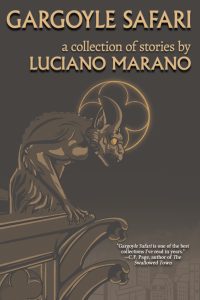
 Gargoyle Safari
Luciano Marano
JournalStone Publishing (February 20, 2026)
Reviewed by Andrew Byers
Luciano Marano is a name I should have been paying attention to before now, and if you read the small-press magazines you probably already were—he’s been turning up in Nightscript, PseudoPod, Chthonic Matter Quarterly, and Year’s Best Hardcore Horror for close to a decade, and he has a werewolf novella trilogy (The Ambush Moon Cycle) and a Dickens-by-way-of-Thomas-Harris Christmas novella (Humbug, Crystal Lake) behind him. Gargoyle Safari is his debut collection: fourteen stories, twelve of them reprints running from 2017 to 2024, plus two originals. C.M. Muller, who edited Nightscript and now runs Chthonic Matter, contributes an introduction in which he says Marano’s range is astonishing. He isn’t wrong, exactly, but I want to push on that a little, because I think the interesting thing about this book is the opposite of range.
Here’s what I noticed about a third of the way in. Marano is a photojournalist by trade, and this collection is obsessed with the person holding the camera. The opener, “The Mythologization of Tymber Prescott in Five Selected Photos,” reconstructs a dead influencer entirely out of her own feed. “To Witness” follows a burned-out news photographer who beats the cops to a wreck on the highway and finds something at the scene considerably worse than a wreck. “Hāʻole” is narrated by a Vietnam combat photographer telling his dead friend’s last ghost story because nobody else will. “My Eyes Are Closed to Your Light” is about a graduate student assembling a book out of a vanished horror writer’s final manuscript pages. Four different subgenres, one preoccupation: what it costs to look at a terrible thing on purpose and write it down. That’s not range; that’s a major theme of the collection, and it’s a better one than the blurbs give Marano credit for.
Gargoyle Safari is at its best when that preoccupation is running. “Tymber Prescott” opens with the line “It helps that she’s dead now, because we never thought of her as a real person anyway,” and then proceeds to earn it. “My Eyes Are Closed to Your Light” is the one I’d hand to a fellow traveler first. Its missing author is named Kane Stryker, which is your first clue, and the story ends with a dedication—the one piece in the book with its own—reading “For Karl Edward Wagner: Something special for the Last Wolf, from a thankful fan.” Marano has written a story about a hard-drinking, difficult, controversial master of the genre who vanishes and leaves behind writings that keep arriving, and about the ambitious student who intends to make her career out of him whether he survives or not. If you know what happened to Wagner, the story lands like a punch. If you don’t, it still works as a nasty little piece about literary vampirism.
The title story, one of the two originals in this collection, is an occult-detective noir about a diviner-for-hire summoned back to his hometown because somebody is taking a hammer to the city’s gargoyles and dropping the pieces on joggers. It’s got the best hardboiled voice in the book—”What kind of lunatic goes jogging in that neighborhood?”—and a genuinely good ending in which the narrator, having learned what’s actually coiled around the heart of the city, takes over the public art fund and starts commissioning new monsters. The catch is that this one is plainly a pilot. The dead alchemist, the father lost in the subway tunnels, the Source of All Shadows—none of that gets resolved here, and I assume Marano intends to come back to it. I hope he does; I’d read a novel in that world tomorrow.
Elsewhere: “‘Till the Road Runs Out” is the splatterpunk entry, a queer Bonnie and Clyde running into a cult that worships death, and it’s as mean as advertised. “The Brief, Reluctant Retirement and Shocking Resurrection of Spooky Sophie,” the other original, gives an aging late-night TV horror hostess a Halloween confrontation with a fan who’s taken her act too much to heart. And then there’s “Shotgun Sunset,” which is two pages narrated by Ernest Hemingway’s shotgun on the morning in Ketchum, and which is the sort of thing that either makes you put the book down or makes you go tell somebody about it. Now I’m telling you about it.
Now the honest part. Marano has a tic, and in a book this size you can’t miss it: he loves a narrator who opens by explaining the rules of storytelling to you. “Black Dog Blues” starts with “Choosing sides; that’s what you’re doing when you tell a story like this.” “Hāʻole” starts with “Stories like this reveal more about the teller than the subject, in my experience.” “Love Is a Ghost You See With Your Heart” runs a page of lovely quiet prose and then breaks frame with “Pretty good start, right?” Individually these are all good moves. Stacked up across a relatively brief collection, the throat-clearing starts to feel like a default setting, and I’d have liked to break up the pattern by rearranging the running order.
Those are quibbles about a debut that’s stronger than most. What Marano has that a lot of his contemporaries don’t is the reporter’s habit of noticing the specific right thing—the meth lab in the back bedroom of the doublewide, the carpet the color of an unimaginative child’s fingerpainting, the barmaid who was nicer to him four days ago. Gargoyle Safari is hardboiled where it wants to be, quiet where it needs to be, and smarter about its own machinery than it lets on. If you like your horror with ink on its hands, this is an easy recommendation.