 The Night Ship
Alex Woodroe
Flame Tree Press (January 20, 2026)
Reviewed by Carson Buckingham
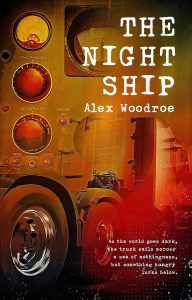
A refreshing new take on apocalyptic novels, Alex Woodroe’s The Night Ship is set in 1980s ultra-repressive Romania, during the waning days of Ceaușescu’s Romanian dictatorship and has three main characters: Gigi, who drives a semi and is a by-the-book ‘party man’; his fiancée and part-time smuggler, Rosi; and a philosophical, Hamlet-esque hitchhiker named Sorin, who is an academic.
The world has been beset by a creeping blackness that seems to be dissolving it. As the three watch, it crumbles away into nothingness. But they take refuge in GiGi’s truck, which somehow manages to float on through the darkness surrounding them without falling into the stygian void beneath them after the area on which they were previously standing falls away into the blackness below. The truck becomes a spacecraft, of sorts.
The fear and paranoia the characters feel could be likened to day-to-day living in a society with secret police, propaganda, citizens informing on each other, and feeling continually off balance as to one’s place in the world.
The story examines the complexity of traumatic experiences and the unique behavior of each character as new and utterly horrific experiences pile up, one by one, creating an accumulation of horror that I’ve not seen the like of since The Haunting of Hill House—and that was released in 1959. And the buildup is done with such a deft hand that it will leave you breathless. This novel is unlike any I’ve previously read… and I mean that in the best way possible. It’s hard to find something new under the sun these days, but if you are searching for the sui generis, The Night Ship is it…in spades, and though you might see elements of Mad Max as well as The Mist, fanfic this is not.
One of my favorite things about this book is that the characters grow as a result of what they experience. “Well, shouldn’t they?” you ask. Of course, they should, but in many books I’ve read, the horror elements so overshadow the personal growth of the characters that the reader doesn’t get to know them at all, and it’s hard to root for someone you don’t know. The novel isn’t just about horror upon horror. It doesn’t have jump scares, but rather, is filled with increasing dread, and we have the privilege of observing how this dread affects and transforms each of these three unwilling voyagers into the unknown. This grounds the story in reality and makes it easy to suspend our disbelief when the horror is brought to the fore, bit by bit.
The darkness is never explained, and I like that. It’s analogous to the authoritarian regime that was running the country at that time. The characters have learned to roll with things and not ask questions. And this apocalypse is just one more thing…a big thing, to be sure…but just one more thing. They cope, but don’t demand answers. They’ve been conditioned to know that they won’t get them, and asking a question in the first place could easily get them something far worse than an answer. It is interesting to note that the new society is almost as bad as the apocalypse that created it, but if there’s one thing the voyagers have is the coping skills they’d developed all their lives from living in Romania. They were coming in handy. When you are traumatized by the very act of living, an apocalypse doesn’t really pack the knockout punch that it normally might.
And there is something in the darkness…but where you have a heartless governmental system, it ruins more than just people, and your heart will break, just a little bit. The book is so very completely, undeniably, well…human.
This is my first Alex Woodroe book. It will most certainly not be my last.
I can’t recommend this book any more highly. If you love a good apocalypse, or even if you’ve never read that sort of book before, you will want to get a copy of this one. Superb in every respect.
5 out of 5 stars.