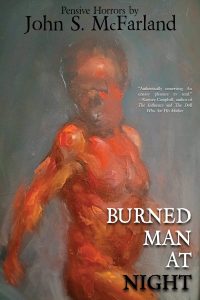
 Burned Man at Night
John S. McFarland
JournalStone Publishing (October 24, 2025)
Reviewed by Andrew Byers
John S. McFarland’s Burned Man at Night is a masterful collection of “pensive horrors” (as the cover suggests) that cements McFarland’s reputation as one of the genre’s best-kept secrets. Drawing from a rich tapestry of historical settings and supernatural unease, McFarland crafts eight stories that linger like shadows in the mind, blending the elegiac with the macabre. His prose, elegant and understated, evokes the likes of Flannery O’Connor and H.P. Lovecraft, while carving out a distinctly modern voice: crisp, focused, and unflinching in its exploration of human frailty.
Set largely in the fictional town of Ste. Odile, Missouri—a pseudo-Lynchian backwater undercut with dusty anguish—the stories feature characters who are scions of crumbling dynasties, cursed lovers, and hopeless souls who find themselves having to grapple with supernatural intrusions. Even tales venturing beyond Ste. Odile carry its spectral influence, extending the town’s shadow like an inescapable fog.
Standouts include “Seeping Toward Gehenna,” a chilling 1348-set narrative of plague profiteering and moral decay, where beauty becomes a tyranny amid festering death. “A Burden of Dust” masterfully weaves cosmic horror into a boy’s Florida exile, his mentor’s occult gifts unleashing aquatic monstrosities that blur survival and nightmare. “Ice Stretching to Darkness” transports readers to a desolate Arctic village, where an ancient sea-hag preys upon grief-stricken families, evoking isolation’s bone-deep terror.
“Oriax of Hell” reimagines Frankensteinian hubris in a Missouri revival tent, with a reanimated giant grappling with his demonic purpose and preachers-turned-con artists. “You Hate Me,” told through a poignant letter, dissects sibling resentment and dysfunction with raw emotional depth, its backwoods voice hauntingly authentic. “The Origin of the World” delves into the horror of a nineteenth-century asylum, where a superintendent’s obsession with female hysteria spirals into depravity.
“The Intercession of the White Worm” is a tour de force, following a Filipino teacher’s emigration to America at the turn of the century, only to become entangled in grotesque medical experiments involving shipworms devouring tumors— a visceral blend of colonialism, science, and body horror. The eponymous “Burned Man at Night” closes the collection with fiery vengeance: a Hungarian immigrant grandfather confronts a spectral figure amid his granddaughter’s murder, fusing folklore, the struggles of cultural assimilation, and supernatural retribution in a blaze of cathartic dread.
McFarland tempers frights with familial sympathy and outsider mercy. His historical details—fashion, medicine, technology—immerse without overwhelming, while interior illustrations add eerie visual punch. This brief collection is concise yet profound. For horror aficionados seeking literary depth over cheap thrills, Burned Man at Night is essential, a brief glimpses into darkness that rivet and unsettle in equal measure.